|
Bank robbery
This is the story of a bank robbery that could happen in the year 2030:
- 0:00:00 – “Hands up,” shouts a masked figure who storms into the bank armed with a gun.
The surveillance camera picks this up and captures the bank employee behind the counter throwing up her hands.This is enough to initiate an immediate electronic security process. The surveillance camera reports the following to the system: “Robbery; perpetrator 1, armed, white shoes.” Communication within the system takes place based on the codes introduced by Interpol in 2028 to describe crimes and disasters.
- 0:00:01 – A small, inconspicuous red light at the exit shows the bank employees that the entrance door is now closed and an alarm call has been automatically triggered.
- 0:00:02 – A bank customer is unable to raise both hands like everyone else present because a suitcase is chained to one hand.
- 0:00:03 – A second man pulls a mask over his face, pounces on the man with the suitcase and drags him towards the exit. The surveillance camera reports something like “use of violence by perpetrator 2 against victim 1, blue jacket, black trousers”.
- 0:00:04 – On the roof of the bank, the small sliding window of a drone port opens and the drone that flies out is the first at the crime scene to take control of the swarm of drones and report the incident to the police station responsible.
- 0:00:05 – The armed offender 1 pushes the next bank customer towards the exit with a gun pointed at him. The surveillance camera reports to the lead drone: „Use of violence by offender 1 on victim 2, green jacket.“
- 0:00:06 – Now Perpetrator 1 realizes that the exit cannot be opened. He turns towards the surveillance camera and angrily demands that the door be unlocked.
- 0:00:10 – The lead drone hovering above the bank asks everyone present to remain calm in a calm, sonorous voice over the loudspeaker in the bank.
- 0:00:15 – The lead drone passes on a suitable order to the artificial intelligence. The AI addresses those present in the same voice and wants a name so that it can communicate personally. It goes on to explain that the electronic door lock can only be unlocked if the threatening shouts stop. It would also be better to put the weapon away. Perpetrator 1 agrees to a conversation but demands that the exit be opened.
- 0:00:30 – Eleven other drones in the city received the lead drone’s alert signal and opened the sliding roofs of their docking stations.
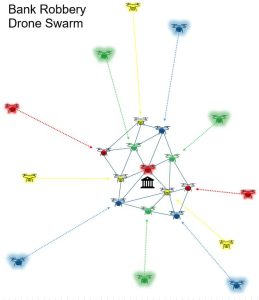
- Based on the feedback received, the lead drone established a command structure and assigned a specific role to each drone. The image illustrates these four roles, each distinguished by a different color. Regardless of the assigned role, every drone receives instructions regarding the specific equipment it must carry.
- The drones use their small gripper arms to pick up the required equipment. The items carried include a spare battery, a canister of pepper spray, a can of spray paint, or a net-capture gun. The drones receive their respective GPS target coordinates – distributed around the bank and the lead drone – and fly to the bank without their flight paths crossing. The resulting formation is determined by the locations of the docking stations.
The equipment is distributed evenly across the swarm. For self-organization to function, it is essential that communication structures and the distribution of equipment remain intact – for example, when the swarm splits.
- 0:02:00 – The first drones have arrived at the bank and are now
 hovering at a height of 200 meters. hovering at a height of 200 meters.
- 0:02:05 – After the door did not open, the perpetrators became loud again and behaved aggressively.
- 0:02:15 – The lead drone, guided by the connected AI, gives the local security system the order to unlock the door. It has achieved its goal and has both perpetrators on the voice recorder.
- 0:02:20 – The bank employee sees that the small red light has gone out and calls out „The door is open again“. Victim 2, threatened with a gun, pushes the door open and leaves the bank with the two masked men and the hostage.
- 0:02:25 – The two kidnappers maneuver their hostage into a waiting car, ignore victim 2 and drive north.
- 0:02:26 – The lead drone informs the operations manager that perpetrators 1 and 2 have left the bank with victim 1 and are getting into a waiting car. In view of the hostage situation, the lead drone calls for an ambulance at the nearest hospital.
- 0:02:28 – The lead drone South determines that Victim 2 should not have left the bank because of the necessary witness statements and sends a drone with a special mission to Victim 2, who is just about to get on a bicycle.
- 0:02:32 – Victim 2 rides away on a bicycle and a drone tries to stop him. The drone flies 3 meters in front of him and says several times: „Please contact the police, they still need a witness statement.“ But the cyclist does not react and tries to hide in a pedestrian zone. The drone reports to the lead drone: „Mission failed“
- 0:03:00 – The lead drone decides that half of the drones should follow the getaway car and draws an east-west dividing line right through the drone swarm. Now there are two independent drone swarms, north and south. What happens to the car with the hostage fleeing north is explained below. Six drones with the lead drone south remain on site.
- 0:03:50 – The police car has now arrived in front of the bank and is recording the statements of the witnesses.
- 0:04:00 – The operations manager checks the surveillance camera video to see what happened before the robbery. He notices that victim 2 did not stand in line at the bank counter and was not interested in any ATM. He now classifies victim 2 as a „suspect“ and informs the lead drone south.
- 0:04:10 – The lead drone South decides that its swarm will now concentrate on the suspect’s escape. Its mission at the bank is over.
- 0:04:15 – Three drones fly back to their drone port and wait for further instructions.
- 0:04:20 – The lead drone North calls on these three drones to join the drone swarm North and bring net guns.
- 0:04:50 – The fugitive disappears with his bicycle into a shopping arcade.
- 0:05:00 – The lead drone now requests support from the artificial intelligence, which tells it the two GPS coordinates of the exits.
- 0:14:50 – Now the fugitive comes out of the second exit without his bike and is spotted by a drone well positioned high in the sky. Due to the unplanned course of events, the lead drone has no information as to when a patrol car might be able to catch him, and so continues to pursue him discreetly.
- 0:20:00 – The fugitive disappears into a restaurant and hopes that the drones lost him while walking through the shopping mall. What he doesn’t know is that the drones could observe him in the city for days because they could alternately charge their batteries or get fresh batteries with their gripper arm. He had no chance.
- 0:36:00 – After half an hour, the police arrive and arrest him. It later emerges that the arrested man was able to monitor the bank entrance from his roof window and found out that the man with the suitcase was depositing large amounts of money every week. It was agreed that the arrested man would be threatened by perpetrator 1 in order to get him out of the bank as an „innocent bystander“.
|
Here are the events in the drone swarm North:
- 0:04:35 – Six drones are following the getaway car at a height of 200 meters. That’s so high that the hijackers cannot see the drones.
- 0:04:50 – The driver cheers and says they got out so quickly that the police couldn’t have given chase. His accomplice grabs the bolt cutters, cuts the chain on the hostage’s wrist, the driver stops, the door opens and the hostage stumbles out – without his suitcase – and the getaway car drives on.
- 0:05:20 – The lead drone North sends a drone down to the freed hostage. The order is: „Assess the condition of victim 1, calm him down and wait until help arrives.“
- 0:05:50 – The drone reports „Victim 1 slightly injured“ and says to the victim: „An ambulance is on the way, we’ll wait together“.
- 0:06:50 – The ambulance arrives at Victim 1 and takes him to the hospital.
- 0:07:00 – The drone reports: “Mission completed” and flies after the swarm.
- 0:07:15 – The driver of the getaway car slams on the brakes when he sees the blue lights of the police roadblock.
- 0:07:16 – A drone equipped with a can of black spray paint swoops down on the car and uses the gripper to open the valve, forming a wide black spray cone. Normally, a drone equipped with such specialized gear can spray a car’s windshield within three seconds, but the driver jerked the steering wheel to the right and turned onto a side street.
- 0:07:35 – Despite the impaired visibility, the getaway car reaches the factory grounds, hoping to hide – or at least conceal the money case – within the abandoned site.
- 0:07:36 – The perpetrators get out and are immediately harassed by mock attacks from several drones.
- 0:07:38 – Net guns are used to prevent perpetrators from running away. Net guns use the pressure of a CO2 cartridge to shoot a nylon net forward. The edges, which are covered with many small barbs, wrap up the victim and get caught. Each drone carries two nets and can prevent a quick escape with a second shot from a different direction.
- 0:08:10 – A police car arrives. The gunman is trying to free himself from the net, while his accomplice, including his suitcase full of money, is tightly wrapped in two nylon nets and stumbles. A police officer gets out and hides behind the car.
- 0:08:30 – The gunman manages to free himself from the net and fires a shot at the police.
- 0:09:00 – In this self-defense situation, a drone uses pepper spray. Both perpetrators are arrested.
Summary assessment:
- The cost of using the security system for the bank is low. The bank purchased a drone including drone port for about $5,000.The bank received free help from drones from other banks, the police, fire brigade and civil protection services and in return participates in other security tasks in the smart city free of charge.
- The need for swarm-capable drones has increased exponentially due to their worldwide use. All industrialized countries are promoting the production of their own drones in order to conquer their global share. This race is not about „higher, faster, further“ because all swarm-capable drones must have the same properties in order to remain compatible with the respective software. These drones from different manufacturers are therefore in comparable competition, which drives down prices and still remains profitable due to the high volumes.
- The driving force behind standardized development was not only governments, but also insurance companies, which, faced with rising crime rates, demanded better insurance coverage or higher insurance rates.
- The swarm intelligence of drones makes it possible to make quick decisions. Fleeing pedestrians and cars are kept on a long leash because they can be easily tracked by a swarm and arrested in better locations. The expensive and dangerous chases in the USA with helicopters and collisions are history.
- The failure of the drone deployment – intended to spray a black film onto the getaway car’s windshield – was due to flawed instructions regarding the police roadblock. The flashing blue lights should not have been switched on so early.
But AI can learn and will make better preparations for the future. The rapid success of this raid can be attributed to the capabilities of swarm intelligence. The communication and video technology used, the flight capabilities of the drones and the equipment used for capture already exist today.
- It should be noted here that a drone could also deploy CS Gas instead of a capture net. However, this would require the decision to deploy it to be made by mission command rather than autonomously by the drone itself.
- Such use in a military context would be prohibited under international law. See Tear Gas
- The rapid success of this raid can be attributed to the capabilities of swarm intelligence.
- The communication and video technology employed, the flight capabilities of the drones, and the equipment used for capture already exist today.
- What is still missing are the necessary foundations for the self-organization of a swarm.
– How does a command structure emerge that utilizes all sources of information, employs artificial intelligence on a case-by-case basis, makes decisions, filters information, and distributes it to the appropriate recipients
– How does such a system remain scalable, allowing drone swarms to change size, splitting and merging – depending on events on the battlefield
– From whom does the mission commander receive continuous updates on key events via multiple video channels, enabling them to intervene in the action if necessary?
Smart homes are for our apartments, but smart cities will only exist when drones have learned to fly with swarm intelligence. This development will usher in a new era. The problem of self-organization is described in the section „Cybernetics Tomorrow“.
|